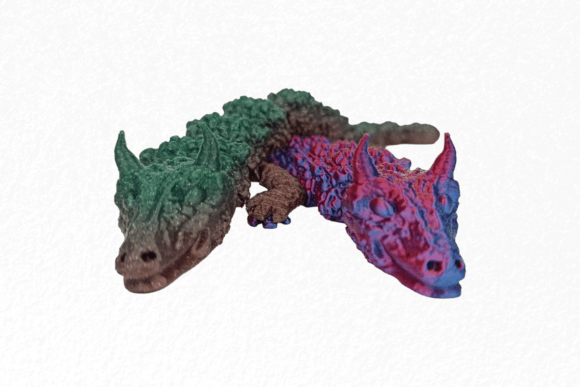
Mineral Flexi Dragon 3D Model for Easy Printing
Fantasy creatures have long captured our imagination, but bringing them to life in the physical world often requires a delicate balance between artistic vision and technical precision. The Mineral Flexi Dragon 3D Model for Easy 3D Printing bridges this gap perfectly by merging the rugged aesthetics of geology with the fluid dynamics of articulated design. This isn't just another dragon figurine; it is a sophisticated print-in-place model that challenges the standard limitations of additive manufacturing while offering an immediate sense of wonder upon completion.
What makes this model particularly compelling for creators, designers, and hobbyists is its unique approach to complexity. Traditional articulated figures often require complex assembly, glue, or hidden internal mechanisms that can fail over time. In contrast, this dragon prints as a single, complete piece straight from the printer bed. The design leverages advanced segmentation to create a fully flexible body that mimics the movement of a living creature without any post-processing. It transforms the act of 3D printing from a purely functional task into a creative exploration of texture, form, and motion.
The Intersection of Geology and Fantasy
The visual identity of the Mineral Flexi Dragon is defined by its surface details. Unlike smooth, stylized dragons found in many commercial designs, this model emphasizes a mineral-like structure. The geometry mimics raw stone forms, featuring jagged edges, crystalline facets, and organic textures that suggest a creature carved from deep earth deposits. This aesthetic choice opens up a world of possibilities for material selection.
When you pair this specific geometry with specialty filaments, the results are transformative. The model was originally printed using PLA Galaxy Rainbow Terra PLA Magic Silk Carnival by Rosa3D. These materials are not merely colorful; they possess light-reflecting properties that interact dynamically with the sharp angles of the dragon's scales. As light hits the textured surface, it creates rich color transitions that highlight the depth of the print. For a maker looking to elevate their portfolio or product line, experimenting with these filaments demonstrates how material choice can redefine the perceived value of a digital asset.
This synergy between texture and material is crucial for anyone looking to create high-quality displays. The stone-inspired surface catches shadows in ways that smooth models do not, giving the figure a weighty, substantial presence even when printed at smaller scales. It appeals to collectors who appreciate the tactile nature of fantasy art and those who want a desk companion that feels grounded and real rather than plastic and generic.
Practical Applications for Makers and Creators
The utility of the Mineral Flexi Dragon 3D Model for Easy 3D Printing extends far beyond simple decoration. Its articulated nature invites interaction, making it an excellent tool for various professional and educational contexts. Here are several ways different users can adapt this model for their specific goals:
- Content Creation and Photography: For bloggers, marketers, and social media influencers, having a unique prop is essential. A poseable dragon allows for dynamic photography where the creature appears to be in mid-flight or coiled around an object. The ability to adjust limbs and tail means you can capture hundreds of variations from a single file, providing fresh content for campaigns without needing multiple physical units.
- Educational Demonstrations: Educators in fields ranging from geology to computer science can use this model to teach complex concepts. The segmented joints serve as a tangible example of kinematics and mechanical linkage, while the mineral texture offers a discussion point on geological formations. It turns abstract concepts into hands-on learning experiences.
- Product Design Prototyping: Freelancers and small business owners can utilize the model as a base for custom merchandise. By scaling the design appropriately and applying unique branding through filament choices, entrepreneurs can create limited-edition collectibles that stand out in a crowded market. The print-in-place feature significantly reduces labor costs, making small-batch production economically viable.
- Therapeutic and Decorative Use: On a personal level, the dragon serves as an effective fidget tool. The satisfying click of the joints and the flexibility of the body provide sensory engagement. Placing such a figure on a workspace can also serve as a conversation starter, reflecting the owner's interest in creativity and technology.
Creative Strategies for Customization
To truly maximize the potential of this model, creators should think beyond the default settings. While the design is robust, exploring different approaches can yield entirely new interpretations. Consider the concept of "bioluminescent minerals." By printing the outer shell in a dark matte filament and using a translucent glow-in-the-dark PLA for the inner joints or specific scale sections, you can create a dragon that seems to emit light from within its rocky exterior.
Another powerful variation involves mixing filaments within a single print. If your printer supports dual extrusion or multi-material switching, you could render the claws and horns in a contrasting metal-infused filament, perhaps copper or bronze, while keeping the body in a slate-gray or obsidian finish. This technique adds a layer of realism and sophistication that appeals to serious collectors.
For those focusing on display, the background matters just as much as the figure itself. Since the dragon is inspired by raw minerals, placing it on a base made of resin, rough-hewn wood, or even a printed cave-like terrain enhances the narrative. The goal is to create a scene where the dragon looks like it has emerged naturally from the environment, rather than simply sitting on a shelf.
Technical Considerations for Success
While the design is optimized for ease of use, understanding the technical constraints ensures the best outcome. One critical factor is scaling. The articulated joints rely on precise clearances to function smoothly. Therefore, it is strongly recommended not to scale the model below 70%. Reducing the size further risks making the gaps between segments too narrow, causing the joints to fuse together during the cooling process or become impossible to move after printing.
If you intend to print a miniature version for a diorama, consider designing a custom base that holds the dragon in a static pose rather than relying on the articulation. However, for the full experience of posing and play, sticking to the original dimensions or scaling up slightly is the most reliable path. Additionally, orientation during printing plays a vital role. Printing the dragon flat on the bed generally yields the smoothest surface finish on the back, which is ideal for display pieces viewed from the front.
Post-processing is minimal but can be impactful. A light sanding of the support structures, if any are needed for overhangs, followed by a gentle application of primer and paint, can further accentuate the mineral texture. Dry brushing techniques work exceptionally well here; applying a lighter color to the raised edges of the scales will make the stone-like details pop dramatically.
Final Thoughts on Creative Integration
The Mineral Flexi Dragon 3D Model for Easy 3D Printing represents more than just a downloadable file; it is a testament to what happens when engineering meets artistic expression. It removes the barriers of assembly, allowing creators to focus on the joy of seeing a complex mechanism come to life in a single build. Whether you are a seasoned engineer testing the limits of your printer, an artist seeking inspiration for a new project, or a teacher looking to engage students, this model offers a versatile platform for innovation.
By embracing the unique textures and capabilities of this design, you contribute to a culture of practical creativity. You are not just printing a toy; you are crafting a piece of art that embodies the resilience of stone and the freedom of flight. As you experiment with different filaments, scales, and environments, remember that the true value lies in how you interpret and present the final result. Let the dragon inspire your next project, whether it ends up on a bookshelf, in a marketing campaign, or as a centerpiece of a classroom exhibit.