Dragon: Where Ancient Legends Meet Modern Typography
There is a distinct moment when a design stops being merely functional and starts telling a story. For creators who need to bridge the gap between historical reverence and high fantasy, Dragon offers a solution that feels less like a software download and more like an artifact unearthed from a forgotten vault. This isn't just another display typeface; it is a visual narrative tool designed to bring ancient legends to life by weaving intricate historical patterns directly into bold, commanding typography.
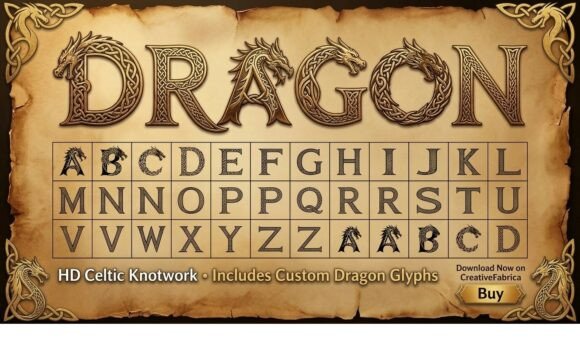
The core appeal of this font lies in its ability to transform simple text into an immersive experience. Every single letter features meticulously designed, interlocking Celtic knotwork woven directly into the bold typography. But the true magic happens when you look closer at the select initial letters. These characters feature striking, aggressive dragon silhouettes seamlessly integrated into the letterforms, turning a standard capital "D" or "A" into a guardian of the page itself. Because of its intense detail and ornamental nature, this font is incredibly powerful when used for large drop caps, monograms, or striking, short titles.
Bringing Mythology to Life in Publishing and Gaming
Imagine opening a new fantasy novel where the first chapter begins with a title that seems to breathe fire, or a role-playing game manual where the character class headers are guarded by serpentine scales. This is where Dragon truly shines. In the world of book publishing, particularly within the genres of epic fantasy, historical fiction, and folklore, the right typeface can set the tone before a single word of the blurb is read.
Publishers often struggle to find fonts that balance readability with atmosphere. Standard gothic scripts can feel too cluttered, while modern sans-serifs lack the necessary gravitas. Dragon solves this by offering a unique middle ground. The interlocking knots provide a texture that feels rich and tactile, mimicking the illuminated manuscripts of the past. When used for drop caps in digital magazines or print editions, these letters act as anchors, drawing the reader's eye immediately into the narrative. The dragon silhouettes embedded in specific initials add a layer of aggression and power that perfectly suits protagonists, villains, or mythical beasts described in the text.
For game designers and tabletop RPG enthusiasts, the font serves as a vital asset for creating immersion. Whether designing a rulebook for a D&D campaign, a cover for a video game, or promotional art for a board game, Dragon provides the instant visual shorthand for "ancient magic." The complexity of the Celtic knotwork rewards close inspection, encouraging players to linger on menus and lore pages. It transforms a standard interface element into a piece of art, making the user feel like they are interacting with a magical tome rather than a digital document.
Elevating Brand Identity in Niche Markets
While the fantasy connection is obvious, the applications of Dragon extend far beyond the realm of wizards and knights. Brands in various industries are increasingly seeking ways to differentiate themselves through heritage and storytelling. Craft breweries, artisanal distilleries, and specialty coffee roasters often rely on narratives of tradition and quality. Here, the Celtic knotwork of Dragon acts as a symbol of continuity and craftsmanship.
A craft brewery might use the font for their flagship label, utilizing the large initial letters to create a striking monogram that stands out on crowded shelves. The aggressive dragon silhouette could be reserved for their strongest ales, subtly communicating potency and intensity without needing to scream "spicy" with loud colors. Similarly, boutique jewelry makers specializing in Celtic-inspired pieces can use this typeface for branding materials, catalogs, and packaging. The font mirrors the intricate metalwork of the products themselves, creating a cohesive brand identity that feels hand-crafted and exclusive.
In the event planning industry, specifically for themed weddings or corporate retreats focused on history and culture, Dragon offers a versatile toolkit. Event coordinators can use the font for invitation suites, seating charts, and menu cards. The ornamental nature of the type allows it to carry the weight of a formal occasion, adding a sense of grandeur and timelessness. By selecting specific letters with dragon motifs, planners can personalize the theme, perhaps using a fierce dragon initial for the groom's side and a more serpentine knot for the bride's, creating a subtle but meaningful visual dialogue.
Practical Applications for Creative Professionals
For graphic designers and illustrators, Dragon is not just a font; it is a starting point for larger compositions. Its strength lies in its ability to function as both text and image. The high level of detail means that when scaled up, the font becomes a complex illustration in itself. This makes it ideal for poster design, album covers for heavy metal or folk-rock bands, and merchandise design.
Consider a musician releasing an album titled "The Iron Serpent." Using Dragon for the title would instantly convey the thematic elements of the music. The interlocking knots could represent the complexity of the lyrics, while the dragon imagery hints at the raw energy of the sound. Merchandise designers can leverage the font's ability to stand alone as a logo. A t-shirt featuring a single, massive "O" with a dragon winding through the center requires no additional graphics to make a statement.
However, working with such a detailed typeface requires a shift in mindset. Unlike standard fonts where legibility is the primary concern, Dragon demands a focus on composition and spacing. Designers must treat each letter as a unique piece of art. The dense knotwork can sometimes reduce readability if the text is set too small or in long paragraphs. Therefore, the most successful implementations of Dragon are those that embrace its limitations. Use it sparingly for impact, allowing the negative space around the ornate letters to do the heavy lifting.
Navigating Strengths and Limitations
To get the most out of Dragon, it is essential to understand where it excels and where it might falter. Its greatest strength is undoubtedly its ability to command attention. In a sea of generic, clean typography, Dragon stands out with its unique fusion of historical pattern and fantasy iconography. It brings a sense of authority and mystique that few other fonts can match. The seamless integration of the dragon silhouettes ensures that the font feels organic rather than forced, adding a layer of sophistication to any project.
On the flip side, the very features that make Dragon special also dictate its usage constraints. The intense detail means it does not scale well down. Trying to use it for body text, footnotes, or small UI elements will result in a muddy, unreadable mess. The interlocking lines will blur together, losing the intricate beauty of the design. Consequently, it is strictly a display font meant for headlines, titles, and short phrases.
Another consideration is the cultural context. While the Celtic knotwork has broad appeal, the specific dragon imagery carries strong associations with Western fantasy tropes. If a project aims for a more neutral or global aesthetic, the aggressive dragon silhouettes might feel too specific or thematic. Designers should weigh whether the "epic, mythical touch" aligns with the overall message. If the goal is to evoke a sense of mystery and power, Dragon is unmatched. If the goal is clarity and minimalism, it may be too overwhelming.
Ultimately, Dragon is a tool for those who want to leave a mark. It is not for the faint of heart or the project that requires subtlety. It is for the bold statement, the legendary tale, and the brand that wants to be remembered as something timeless and powerful. When applied with care and an understanding of its ornamental nature, it transforms ordinary designs into experiences that resonate with the audience long after they have looked away.